
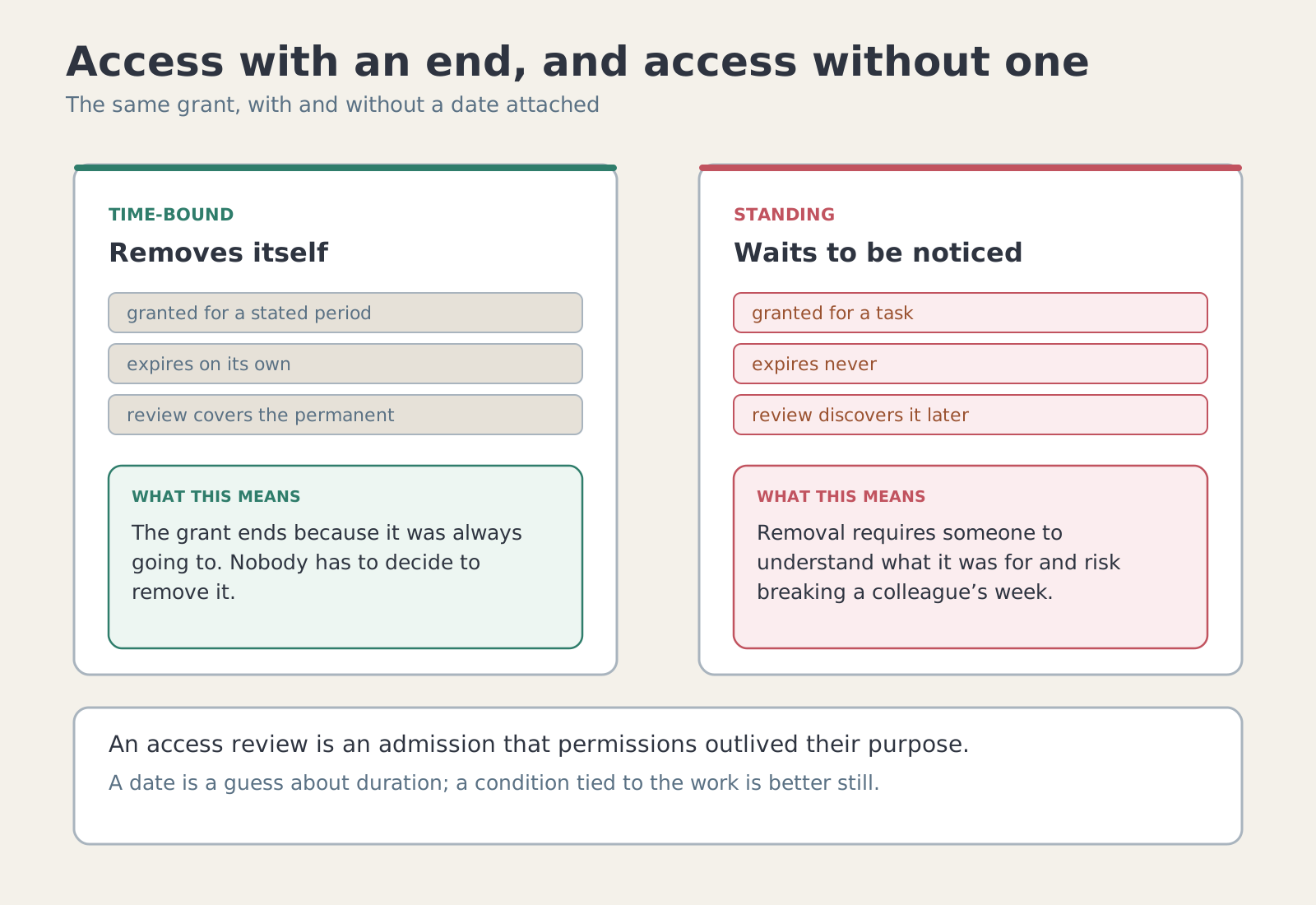
“Temporary” access often becomes permanent when the grant is easy to create and difficult to revisit. Expiration can reduce that drift, but only when tied to a real operational event and backed by an enforcement path.
Start with the reason and duration
Ask why access is needed and what event ends the need: the end of an incident, a project milestone, a contract or a scheduled review. The right duration depends on the task and its risk. A generic short lifetime can interrupt essential work; an indefinite grant can outlive the requirement.
High-impact privileges need a clear owner, justification and review point. A low-risk read-only grant may need a different process. Make the rationale visible rather than hiding it in a duration field.
Expiry needs enforcement, not just a date
An expiry timestamp in a request record does not remove access by itself. The enforcement path must revoke or re-evaluate the assignment and account for sessions, tokens and downstream applications where relevant. Test what happens if the scheduled process is delayed or a dependent system is unavailable.
If the product or integration does not support automatic expiry for a grant, state that limitation and use a tracked review or manual removal process. A reminder is not equivalent to revocation; that distinction matters when making security or compliance claims.
Handle extensions as new decisions
Extensions should not be silent defaults. Ask whether the original reason still holds, who accepts the residual risk and how long the new period should last. Sensitive grants may require a different approver from the original requester.
Repeated renewals can reveal that a temporary task has become a permanent responsibility. That work may deserve a normal role or service identity rather than another temporary exception. Use expiry to improve the access model, not just to generate more paperwork.
Prove the end state
Test that permission is no longer effective after expiry, including through existing sessions and integration credentials according to the intended policy. Confirm the audit record shows the original grant, any extension and the removal decision.
Monitor failures and exceptions. An expired grant that remains active should be visible to an owner and responder. Operational reliability matters because a time-bound rule is only as strong as the process that applies it.
Four questions for your stack
Tie each temporary grant to a purpose, owner and meaningful end event?
Confirm the mechanism can enforce expiry?
Require an explicit extension decision and record repeated renewals?
Test actual denial after expiry, including downstream access?