
Compliance obligations differ by organisation, jurisdiction and contract, so no single feature guarantees compliance. Yet architecture determines how much work is needed to demonstrate control: whether access decisions are recorded, permissions can be reviewed and changes are traceable.
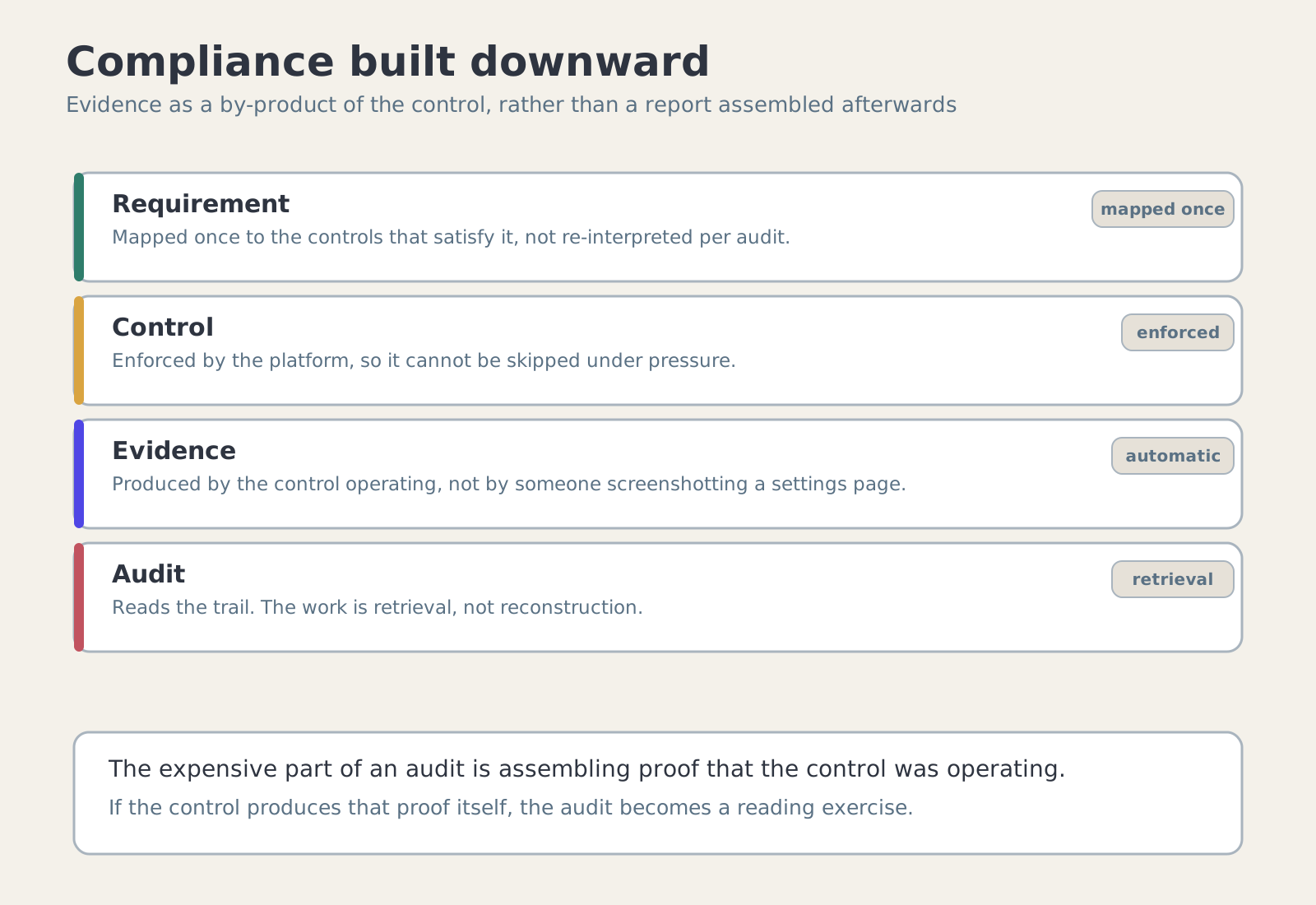
Turn requirements into observable controls
Begin with the question an auditor or reviewer will ask. Who had access to this resource? What policy justified it? Who approved the change? When was access removed? Which administrator changed the configuration? Map each question to a control and an evidence source.
WebFrolic’s security paper describes immutable audit capture for actions on resources, including user, session and device context. Verify event coverage, retention and access controls in the actual deployment instead of assuming every compliance requirement is covered.
Connect lifecycle to governance
Provisioning and deprovisioning demonstrate that access follows an identity’s lifecycle. Requests and approvals demonstrate that new privileges pass through a decision process. Periodic review helps identify grants that no longer fit. These controls are stronger when events, assignments and the final enforcement outcome can be connected.
Make exceptions visible. A written policy can be weakened by ad hoc grants, undocumented support actions or unused privileges. Record the reason, owner, scope and review date for exceptions and make their eventual removal easy to verify.
Do not confuse a feature with an attestation
A product may provide logs, session controls or network rules, but an organisation still needs to configure them, operate the process and evaluate whether the control meets its obligations. A capability claim is not the same as an independent certification or audit opinion.
When publishing security material, state what the product supports, what administrators must configure and what has been independently assessed. Do not imply a certification, regulatory approval or audit result unless it can be substantiated.
Make evidence usable by humans
Evidence should be discoverable and interpretable by people who did not implement the system. Document event fields, retention, export path, access restrictions and known gaps. Use consistent terminology across policy screens, API responses and audit records.
Run an evidence exercise before a formal audit. Trace an access request from approval to assignment and later revocation, or reconstruct a sensitive recovery from the audit trail. The exercise reveals missing joins and manual steps while there is still time to improve them.
Put it into practice
Prove it on your side
- Map obligations to controls, owners and evidence sources.
- Trace access from request through approval, enforcement and revocation.
- Document the difference between product capability and certification.
- Run evidence retrieval exercises before formal review.