
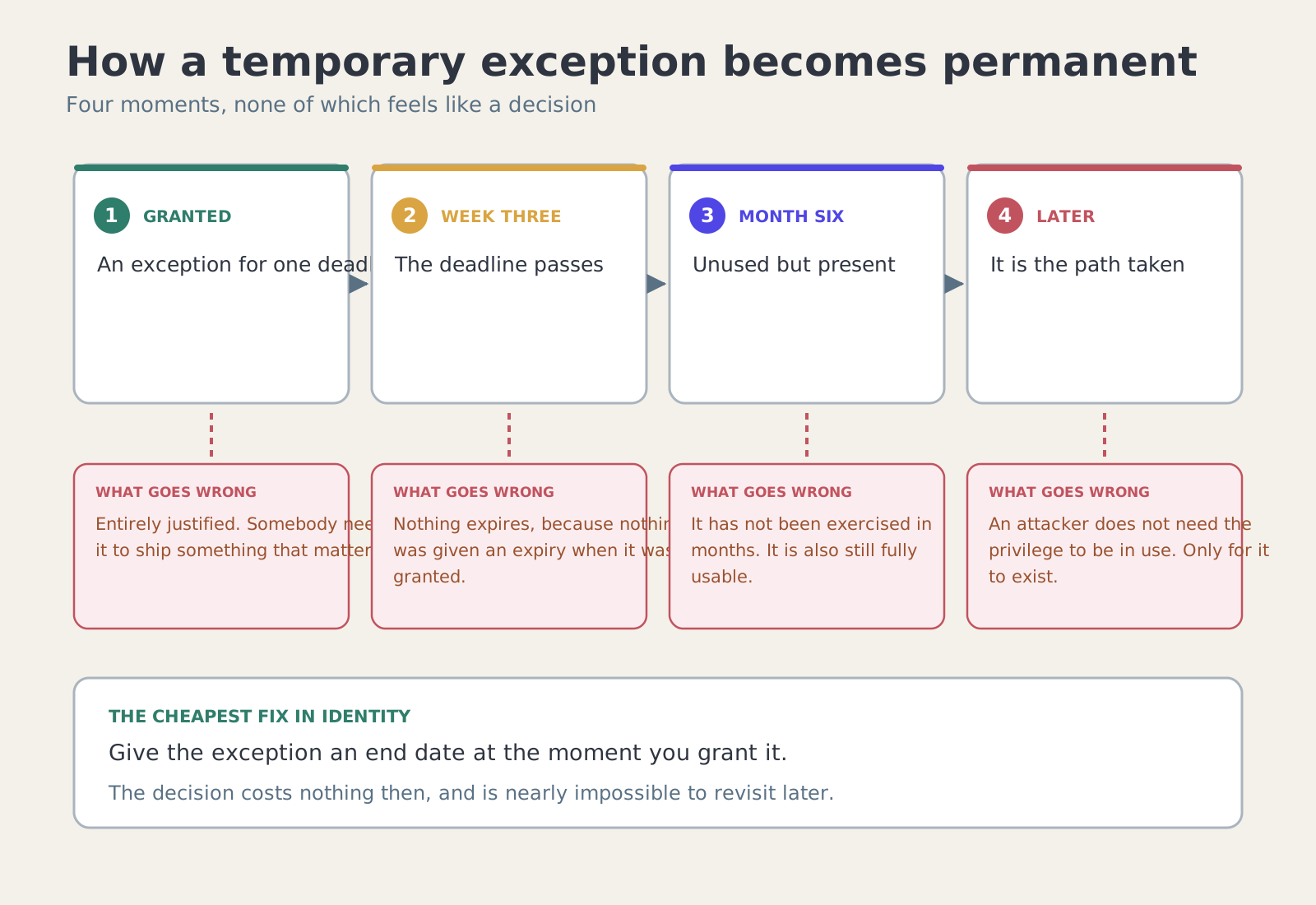
Access policies often look strongest in the document and weakest in the exceptions list. A grant solves an urgent problem, a special case avoids the normal flow, or a role remains after the original task ends. Each decision may be reasonable in isolation, but accumulated exceptions become difficult to understand.
Record the reason for an exception
Every exception should have a defined scope, owner, reason and review point. Make clear which rule is being bypassed and what compensating control is used, if any. Without context, later reviewers cannot tell whether the exception remains necessary or was simply forgotten.
Avoid free-form exception processes that differ by team. Provide a consistent route for requesting, approving, monitoring and ending exceptions. High-impact changes may need independent approval or a shorter review interval than low-risk adjustments.
Look for privileges that are never used
Unused access may mean a grant is no longer needed, but absence of activity is not proof. A role may be needed for emergency response or a quarterly process. Use activity evidence alongside ownership, purpose and business context before deciding to remove it.
Misunderstood privileges are also risky. If users do not understand what a role enables, they may approve access without understanding its reach. Descriptions should explain the resource and actions, not merely repeat a technical role name.
Make removal a normal outcome
A review should be able to reduce or revoke an assignment without inventing a separate workflow. Track who performs the change and confirm the downstream system enforces it. If removal cannot be automated, make the task visible and assign an owner.
Repeated exceptions often indicate a missing role, service identity or better workflow. Instead of approving the same workaround every month, examine whether the underlying operating model needs a first-class construct.
Use evidence to improve policy
Review the age of exceptions, number of renewals, unused high-impact grants and unresolved removal tasks. These measures help find where written policy and day-to-day reality diverge, though they do not decide the risk question by themselves.
WebFrolic’s security paper calls out exceptions, unused privileges and privileges whose impact is misunderstood as policy gaps. Use those observations to build a feedback loop between access decisions, reviews and product configuration.
Put it into practice
A checklist you can reuse
- Require owner, reason, scope and review date for exceptions.
- Use activity data with business context to review unused privileges.
- Make revocation and remediation trackable outcomes.
- Turn recurring exceptions into candidates for better roles or workflows.