
Launch customer identity
Give each B2B customer a clear tenant boundary for members, SSO, provisioning and tenant-level policy.
Explore customer identityB2B SaaS identity, access and operations
Bring customer, workforce and service identities into one connected model. Keep tenant boundaries clear, enforce permissions where resources are protected, and make important changes reviewable through an audit trail.
A connected model for customer, workforce and service identities—with policy boundaries that remain explicit.
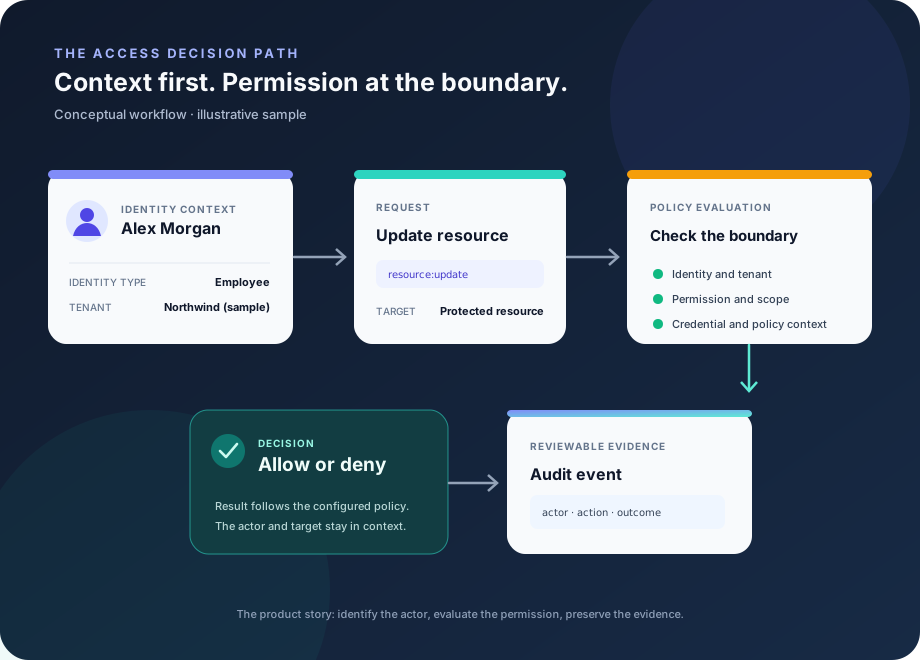
Illustrative workflow based on the documented product model—not a live console screenshot. Exact behavior depends on configuration.
Start with the job to be done
Explore WebFrolic through the work your team is responsible for. Each path connects the relevant identity boundary, access controls and operational capabilities.
Give each B2B customer a clear tenant boundary for members, SSO, provisioning and tenant-level policy.
Explore customer identityConnect employee identity, self-service, lifecycle changes and role-aware access.
Explore workforce identityMake resources, permissions, API credentials and access decisions explicit.
Explore authorizationSupport account changes, service requests and repeatable workflows with clear ownership.
Explore operationsSee the model at work
Choose a common situation to see the identity context, the controls involved and the evidence you should expect to review. These are explanatory workflows based on the documented product model; they are not a live product simulation.
Scenario 01
A customer joins the company as an employee. The identity classification needs to reflect the new relationship, with employee-specific controls rather than leaving elevated access on a customer identity.
Scenario 02
A B2B customer needs to manage its members and enterprise integration while the platform owner retains control of global identity policy.
Scenario 03
Recovery is a sensitive identity operation. The product design limits what support staff can do and gives administrators controls over recovery requirements and the aftermath.
Explore the supporting material: Product guide → Console documentation → API reference →
Security you can inspect
Identity security is made of edge cases and transitions. WebFrolic's design focuses on controls that should be visible, testable and auditable—not merely listed on a page.
Signup, authentication, enrollment, recovery and authorization steps are modeled with server-side state and validation rules for allowed transitions.
Read the design →Rate limits can be set by user, session, tenant, IP address and operation. Network controls can apply to roles, identities, tenants, integrations, apps, service accounts and API keys.
Review the controls →Actions on resources are captured with user, session and device context. End users and administrators can also see and control sessions and API keys.
See the principles →Common questions
The initial story is especially relevant to B2B software companies managing tenant members, customer identities, employee access and support operations. The product also documents customer, employee, administrator, tenant-administrator, support, auditor, service and machine identity models.
The product documentation describes OpenID Connect for authentication, OAuth 2.1 for authentication and authorization use cases, SAML 2.0 and SCIM provisioning. OAuth 2.1 requires PKCE for authorization-code flows, and the same requirement applies to OIDC. Review the API reference and product documentation for scope and operations.
Start with the product guide and architecture explanations, then ask for a walkthrough of the exact policy and recovery paths you need. We do not publish invented customer results or claim certifications that are not documented.
Talk through your architecture
Tell us what you use today for customer sign-in, workforce access, tenant administration or support workflows. We'll work through the fit with you, including the parts that need a closer technical look.