
A request process can be efficient yet create access nobody revisits. A review can be thorough yet lack context about why a grant was originally approved. The governance loop connects initial purpose to current permission and eventual removal.
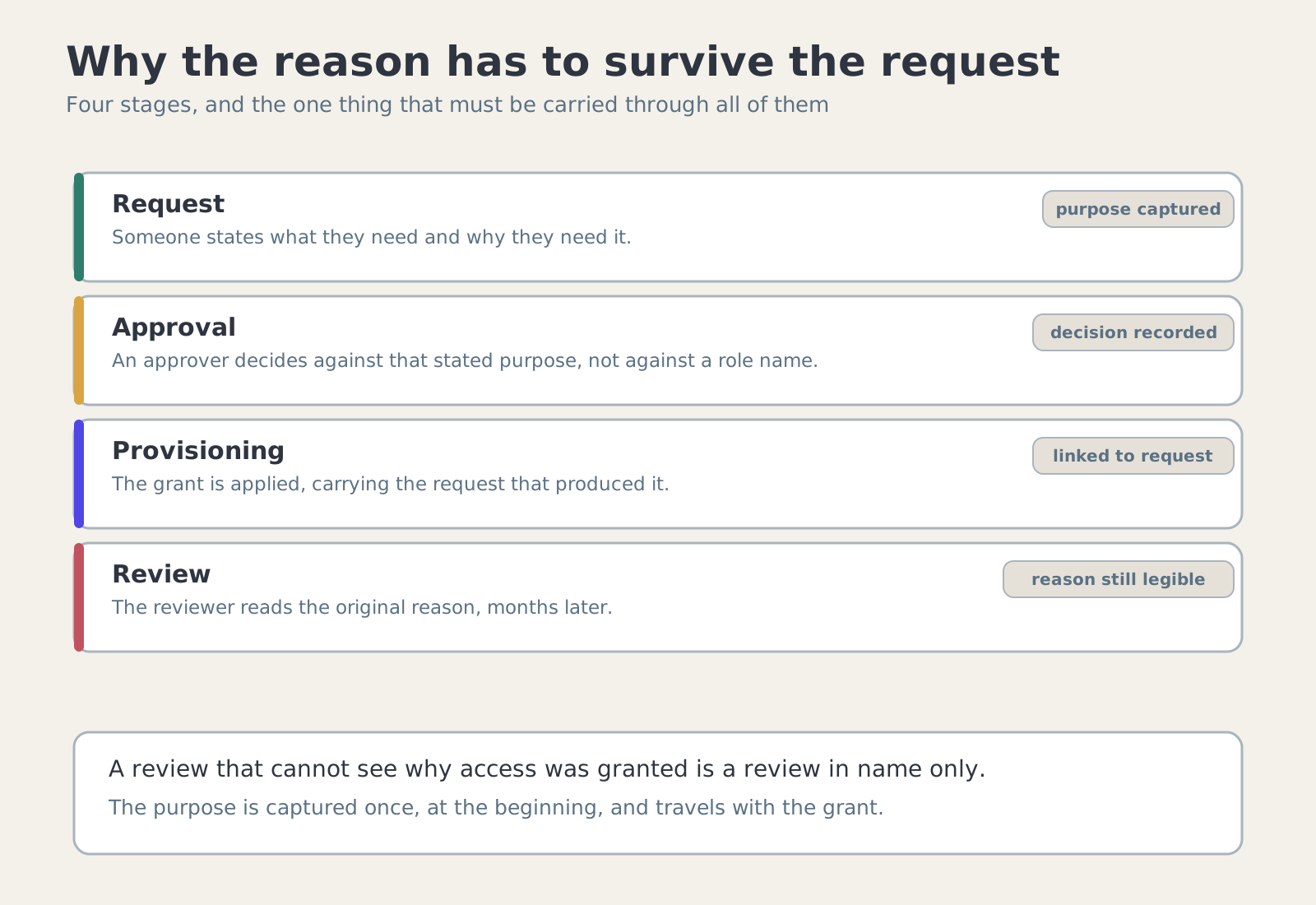
Capture purpose at request time
Ask the requester to identify the resource, action and business purpose. Choose the smallest useful scope and identify the owner who can judge the need. A request that says only “admin access required” gives the reviewer little basis for a risk decision.
Where appropriate, include duration, tenant context and dependencies. Someone asking for access to one customer organisation should not receive platform-wide privileges merely because that role is easier to assign.
Make approval meaningful
The approver should see what the assignment allows, why it is needed and whether the requester already has overlapping access. Separate requesting, approving and enforcing responsibilities where risk requires it, especially for privileged roles.
WebFrolic’s employee dashboard notes include resource access requests and review/approval workflows. Validate who may approve each request type, what evidence is retained and how the final assignment is tied to the approved scope.
Carry the decision into the review
A review is stronger when the reviewer can see original purpose, approval, owner and changes since the grant. Ask whether the need still exists, not only whether the person remains in the department. A role can be technically valid even when its original business purpose has ended.
Review outcomes should be enforceable: retain, reduce, revoke or escalate. Track how quickly the system reflects a rejected grant and surface downstream failures. Closing a review task without changing the permission weakens the loop.
Close the loop with evidence
Connect request, approval, assignment, later review and revocation through stable identifiers or audit context. This explains who authorised access and who later decided it should end. It also makes repeated exceptions easier to spot.
If users routinely request broad roles because no suitable scoped role exists, improve role design. Governance becomes effective when product design and operating habits support each other.
In practice
Capture purpose and resource scope before approval.
Separate requester, approver and enforcement where risk requires.
Carry original justification into periodic reviews.
Verify that rejected access is actually changed or removed.