
Many account pages show recent sign-ins, but visibility is only the first half of session management. Users and administrators also need a safe way to end a session and understand what that action does—and does not—invalidate.
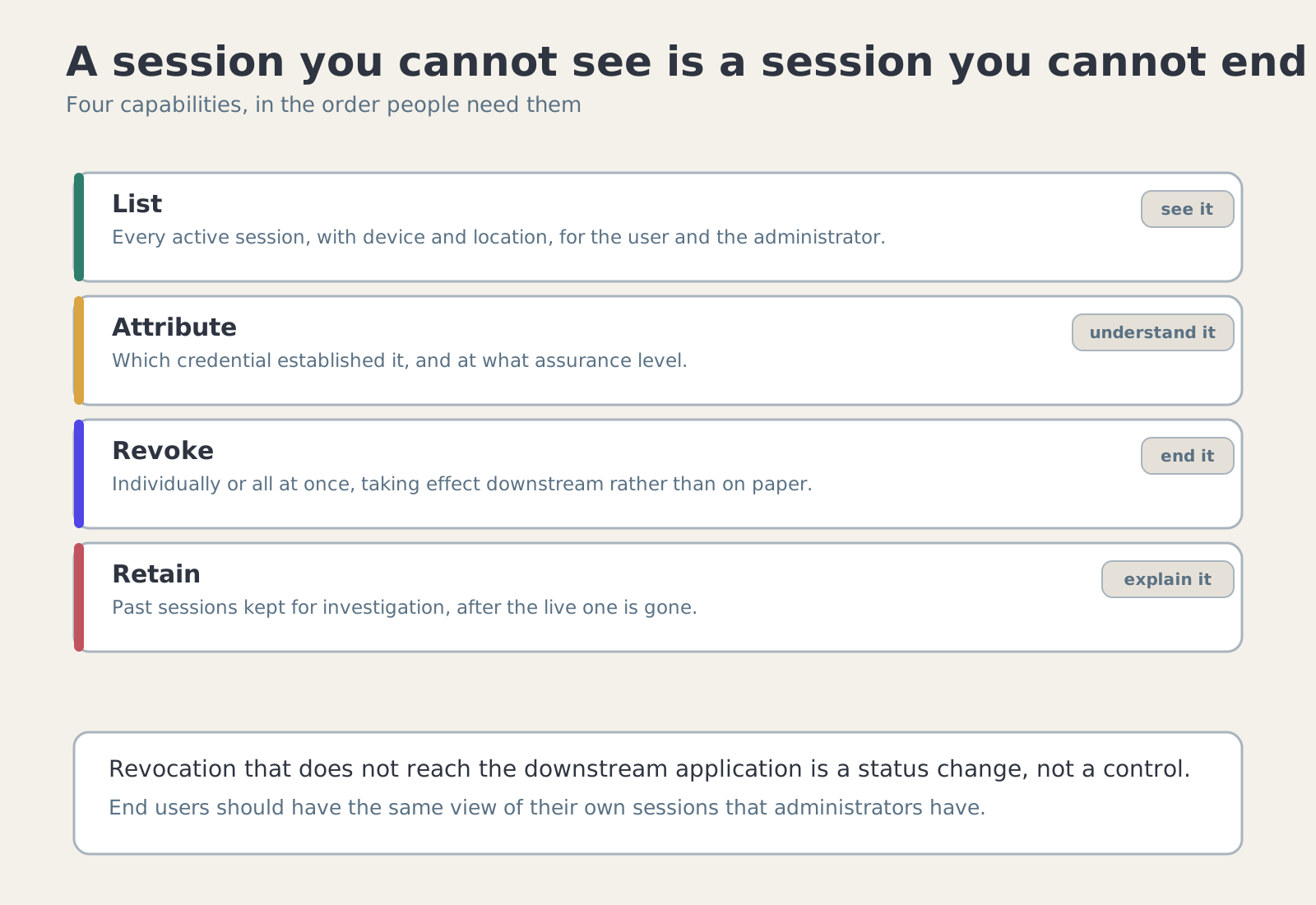
Treat a session as an active security relationship
A session reflects a prior authentication event combined with duration, inactivity and policy constraints. Multiple sessions can exist at once, and a stolen session may remain useful after a password change if the system does not revoke it under the intended policy.
WebFrolic documents visibility and control for active and past sessions for administrators and end users, extending similar visibility to API keys. The implementation question is which actions revoke which sessions and how quickly the result is enforced across services.
Show enough context to recognise suspicious activity
A session list should help an account owner distinguish expected activity from something unfamiliar. Depending on what the system collects, useful context may include creation time, last activity, device or browser signal, network and approximate location. An IP-based location is not proof of a person’s physical presence.
Avoid exposing details to roles that do not need them. Balance user comprehension, privacy and operational utility so an administrator can investigate without turning session metadata into an unnecessary source of personal data.
Make revocation behaviour explicit
Users should know whether “sign out this session” revokes one session or every active session, and whether API keys are affected. Recovery and suspected compromise may require a broader response than a routine logout. Explain those distinctions in the interface and support guidance.
Test with more than one browser or device. After revocation, confirm the old session cannot access protected routes or silently refresh. If tokens or caches remain valid for a window, document the residual risk and the controls that limit it.
Use session policy deliberately
Maximum duration, inactivity timeout and maximum active-session count have different goals. Shortening every setting indiscriminately can create friction without addressing the highest-risk paths. Configure by identity classification and resource context, then measure actual impact.
Look for unusual session patterns, rapid credential changes and activity after recovery. Session telemetry is not an incident response plan by itself, but it supplies evidence and containment options when a credential or device may be compromised.
Four questions for your stack
Provide useful, privacy-conscious session context?
Explain single-session versus all-session revocation?
Test revocation across devices, refresh paths and downstream services?
Align duration, inactivity and concurrency limits with identity risk?