
Security controls can fail through bugs, configuration mistakes or compromised integrations. A system that can only disable a feature globally may force teams to choose between leaving risk open and interrupting every user. Incident design should provide precise options.
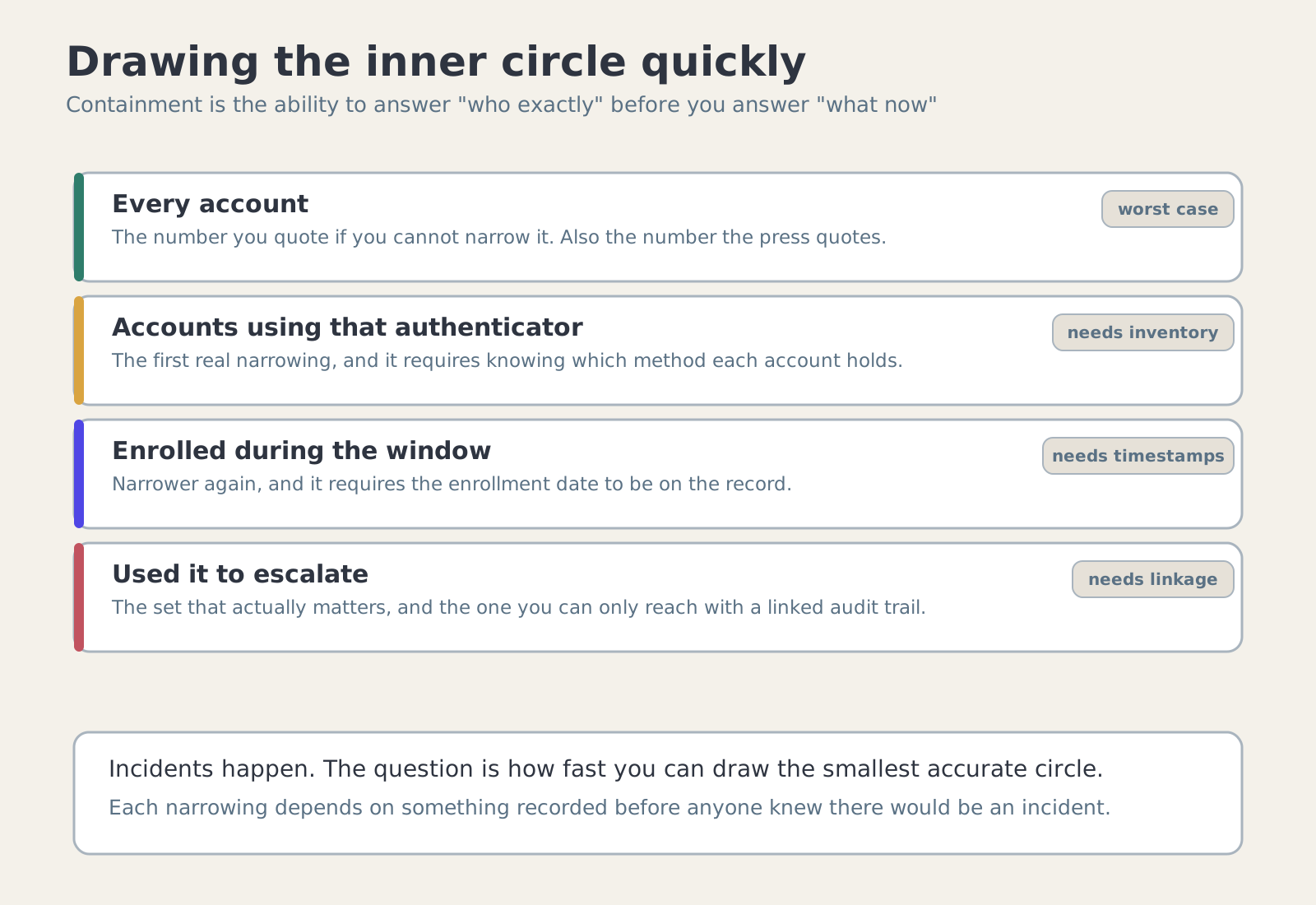
Know which identities were exposed
Keep enough provenance to identify accounts created through a particular authenticator, flow version or policy configuration. If the system cannot answer that question, response teams may have to treat a much larger population as affected.
WebFrolic’s security philosophy explicitly emphasises blast-radius containment: identify accounts associated with a flawed authenticator and prompt them for additional verification where appropriate. That requires useful relationships between configuration, transactions and affected identities.
Separate detection from containment
Detection might come from unusual signups, anomalous recovery, a reported bypass or an external disclosure. Responders need a decision tree: stop new use, restrict the authenticator, invalidate relevant sessions or credentials, and increase verification for the impacted population.
The correct action depends on the failure. A weak enrolment path differs from a leaked API key or expired signing certificate. Define response options in advance, name the decision owner and capture why a response was selected.
Preserve service while reducing risk
A broad outage may be necessary for some incidents, but not every failure requires one. If the affected population is identifiable, targeted re-verification or selective restriction may reduce disruption. Precision depends on trustworthy records and policy controls that can be changed without an unreviewed backdoor.
Communicate consequences. Users may need to re-enrol credentials, review sessions or restore integrations after keys are revoked. Support and service-desk runbooks should be ready for increased demand without granting operators new ways around containment policy.
Learn from the incident
After containment, reconstruct the transition that failed and add tests around it. Review whether monitoring detected the issue, audit records identified affected accounts, and rollback or emergency policy changes were usable. Treat the incident as input to architecture and release validation.
Run tabletop scenarios before a real incident. Measure how long it takes to identify affected identities, stop exposure, contact users and verify remediation. These exercises reveal missing ownership or data relationships while the stakes are manageable.
What to ask your own team
Track which identities and transactions used the affected authenticator or policy?
Prepare scoped disablement, revocation and re-verification actions?
Align support and communications with the containment plan?
Run tabletop exercises and convert findings into regression tests?