
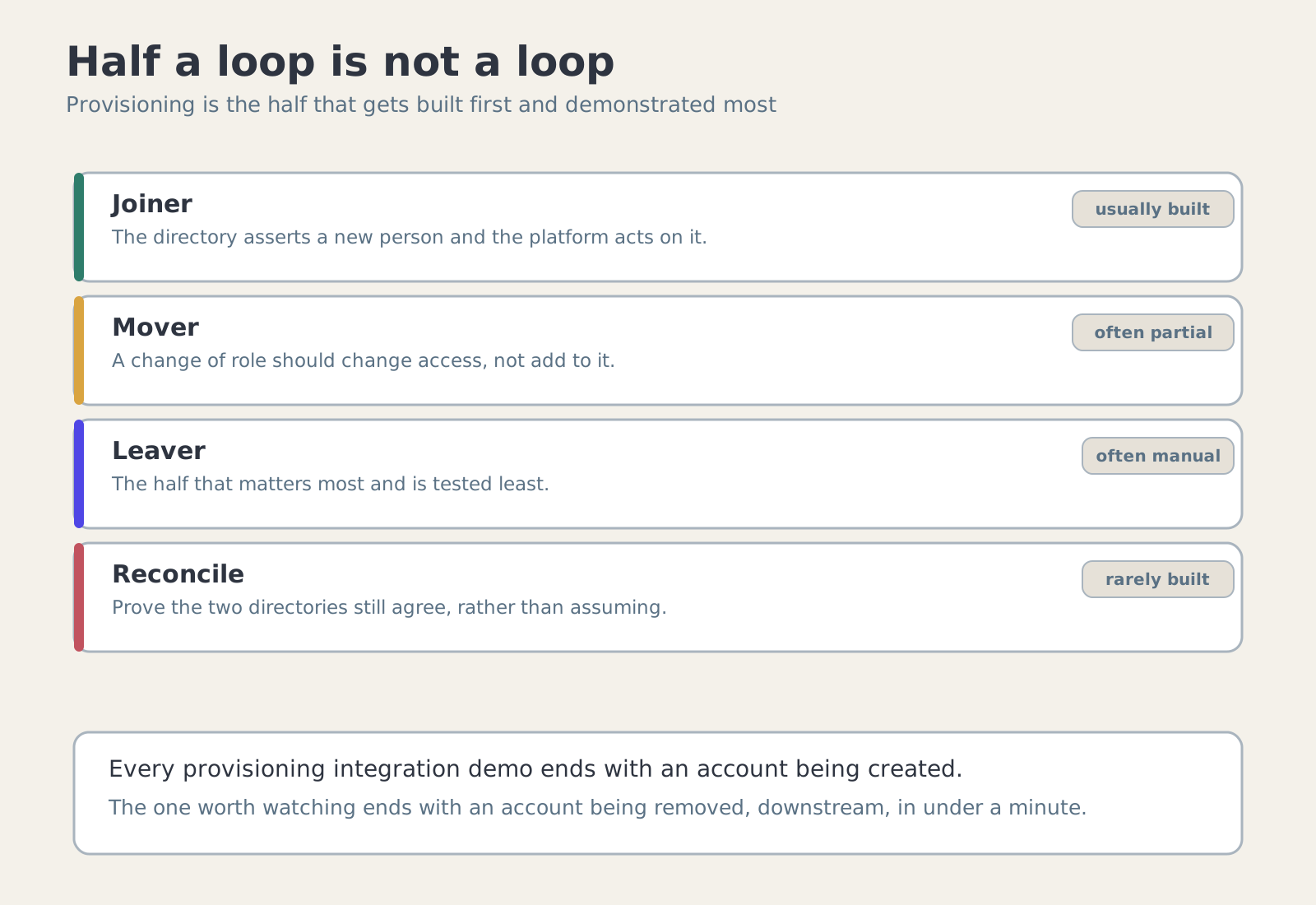
Automated provisioning reduces manual work, but a process that creates accounts reliably while leaving stale access behind has automated only half the problem. The environment can look efficient while permissions accumulate quietly.
Model states, not isolated commands
Define lifecycle states for people, memberships, credentials, groups and application assignments. “Active”, “suspended”, “transferred” and “removed” should have clear meanings and permitted transitions. Decide what each state allows before implementing the endpoint that changes it.
Make events idempotent where possible. Receiving the same deactivation twice should not restore access or create an ambiguous record. Retries, partial outages and delayed callbacks are normal distributed-system conditions; the lifecycle must remain safe under them.
Decide which system owns each attribute
A directory may be authoritative for employment status while a tenant administrator owns a customer member’s group assignments. Avoid letting multiple systems overwrite the same field without a priority rule. Record which system owns each relationship and what happens when two sources disagree.
Mappings should cover creation, update and deletion. Domain-based matching may help initial assignment, but it should not replace stable identifiers or explicit membership policy. Changes to external identifiers need a deliberate rule: update the same identity, or create a new record?
Design for partial failure
A provisioning job can succeed in one downstream application and fail in another. Report partial completion, retain retry context and make unresolved work easy to investigate. Silent failure is particularly dangerous during deprovisioning because the source system may say “removed” while the target still accepts access.
Reconciliation should compare intended and observed state, but not blindly delete every difference. Apply a known ownership and conflict policy. High-impact changes may require approval; routine low-risk corrections can be automated if the expected outcome is clear.
Make changes explainable
Capture the source event, mapping rule, target systems updated and any retry or manual decision. This helps operators distinguish expected automation from unexpected permission drift. It also makes it possible to find which step failed when multiple applications were involved.
Measure provisioning delay, deprovisioning delay, failure rate and the age of unresolved exceptions. These indicators reveal more than an account-creation count because they show whether intended access stays correct over time.
What to ask your own team
Define lifecycle states and valid transitions?
Document authoritative sources and mapping rules?
Handle retries, partial failures and reconciliation explicitly?
Record unresolved differences with an owner?