
During an incident review the question is rarely “what ran?” It is “who caused this to run, and were they entitled to?” An audit trail that records only the service account cannot answer either half, and that gap widens every time an agent is given something new to do.
Why single attribution fails
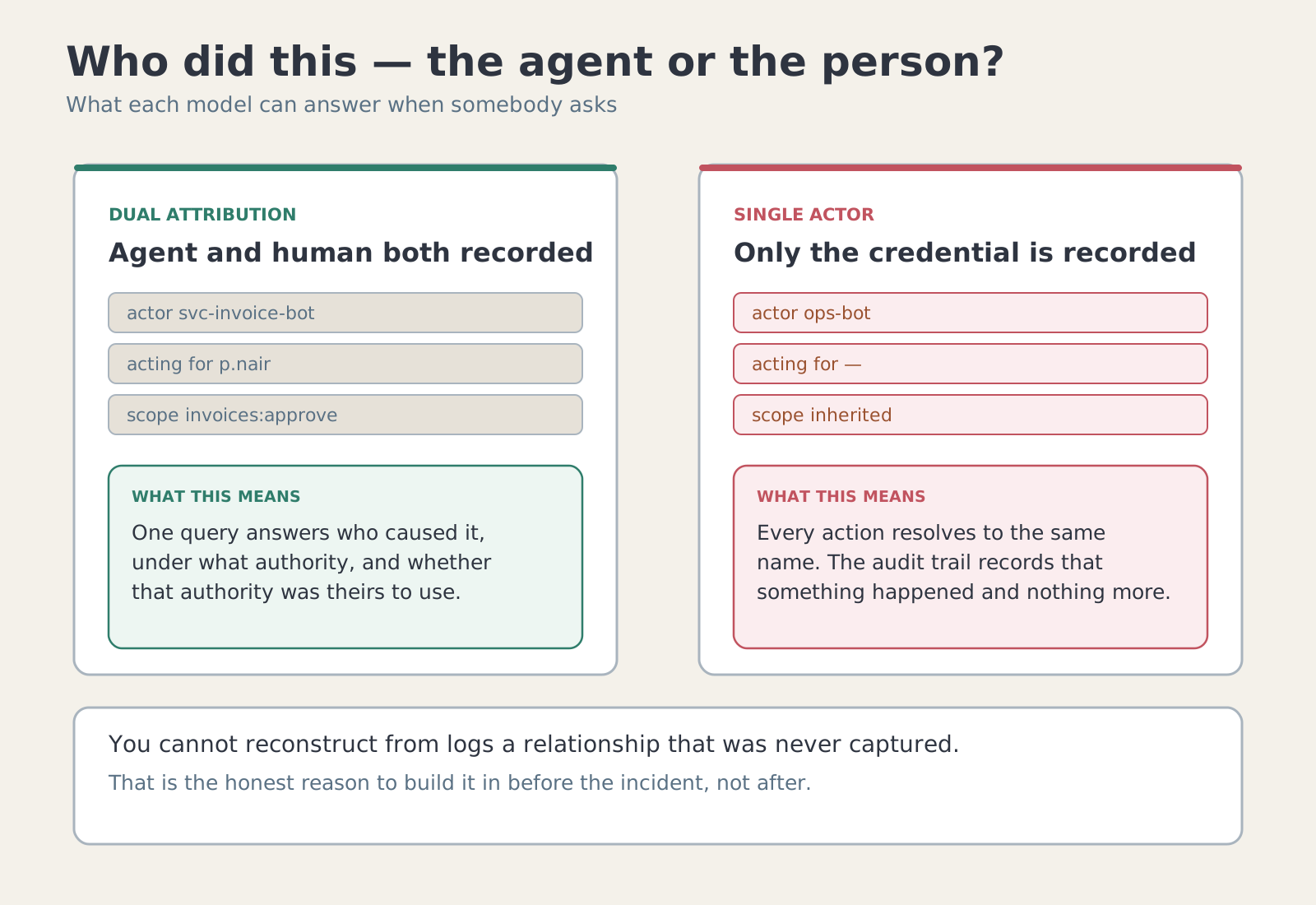
A credential-based model records the credential. If five people can use the same service account, every action resolves to the same name, and the audit trail becomes a list of things that happened with no accountable party attached.
This is tolerable while automation is small and well understood. It stops being tolerable when agents act continuously, because the volume of actions rises while the information per action stays the same.
Dual attribution, and what it costs
The alternative is to record both parties: the identity that performed the action, and the human on whose behalf it was performed, along with the session and the scope in force at the time. Because a service identity can only be assumed by one person at a time, that second name is unambiguous rather than inferred.
The cost is that the relationship has to exist in the model. You cannot reconstruct who was behind an action from logs that never captured it — which is the honest reason to build it in before you need it.
Separating authority from execution
Dual attribution also makes an important distinction visible: the agent executed the action, but the authority came from somewhere. If the scope granted to the agent was narrower than the person’s own permissions, the record shows both the ceiling and what was actually used.
That is the difference between knowing an agent had access and knowing what it did with it.
What it enables afterwards
Once both names are recorded, ordinary questions become answerable. Which agents act for people who have since changed role? Which grants were used once and never again? Which actions happened outside the window the grant was meant to cover?
None of those require new tooling. They require the audit record to have carried enough at the time.
If you take one thing
Does an agent action resolve to a named human without guesswork?. Then: does an agent action resolve to a named human without guesswork?; is the scope in force at the time recorded, not just the agent’s maximum?; can two people hold the same agent identity simultaneously? If so, attribution is already ambiguous.