
Imagine a user who once assumed a high-privilege role requiring strong authentication. Later, the user needs to replace a lost credential but cannot satisfy the same requirement because the unavailable credential is the one needed to change. A well-intended rule can become a trap.
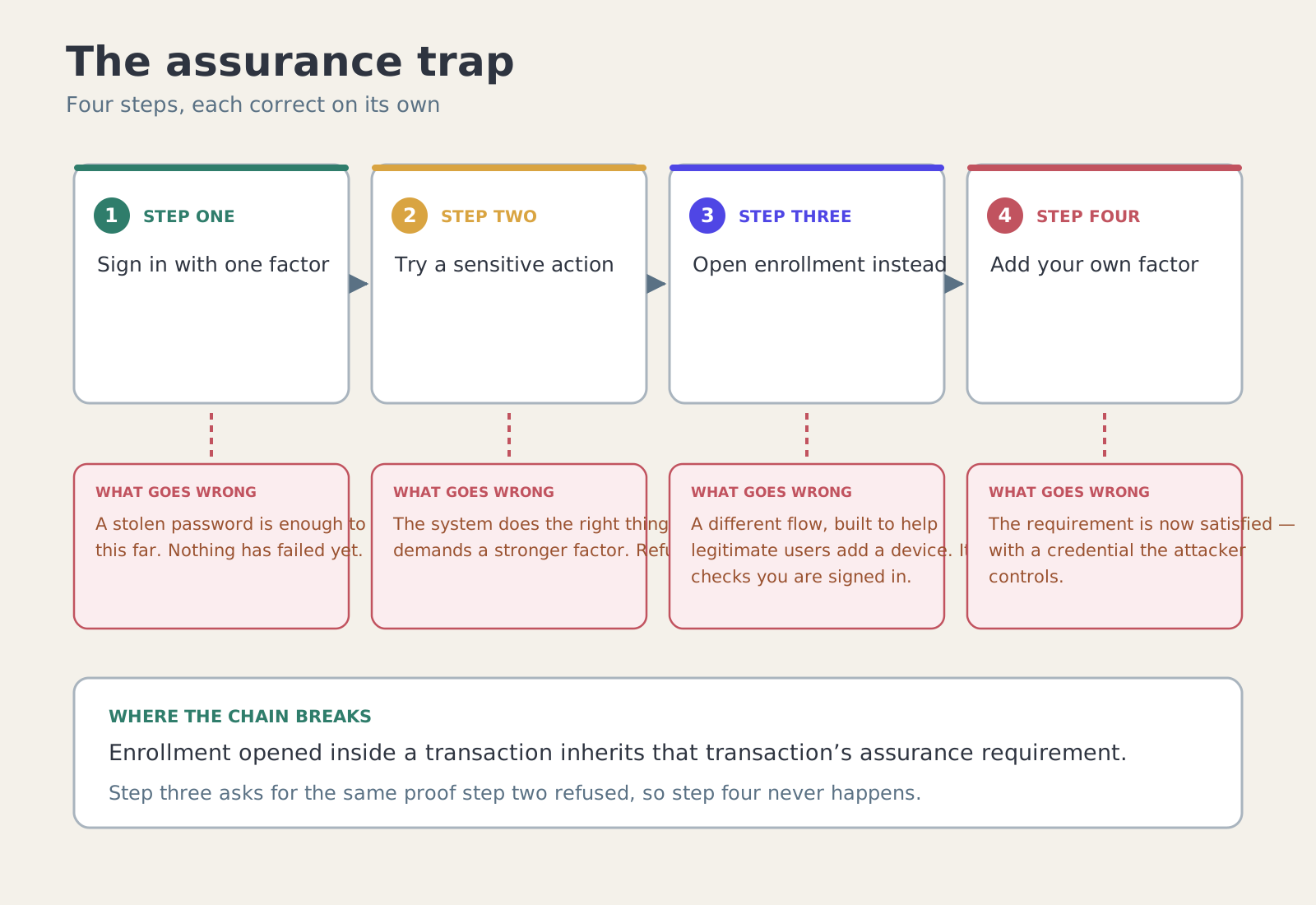
How the trap appears
The system derives an assurance requirement from a role, application or dashboard, then applies it to later credential changes. That consistency may be intentional: changing an authenticator is security-sensitive. The difficulty begins when the current credential set cannot meet the threshold and no safe transition out of the state exists.
WebFrolic’s security notes describe this tension. Recovery can provide a route forward, but the documented recovery behaviour may revoke API keys, which has operational consequences. A higher-privilege administrator may have a credential-removal mechanism to help the user enrol a replacement.
Do not weaken the rule silently
Exempting credential changes from assurance checks can let a hijacked session enrol an attacker-controlled authenticator. Any exception should be a separate recovery path with explicit proof, policy and audit requirements, not a quiet hole in the normal flow.
A recovery design must consider lost devices, changed roles, inaccessible authenticators and accounts whose recovery methods are compromised. The goal is not convenience at any cost; it is a secure route back to a valid credential state.
Make recovery consequences visible
Before a user starts recovery, explain what will happen to existing authenticators, API keys, sessions and integrations. For sensitive identities, a temporary lock or additional verification may be appropriate. Operational teams should know how to restore affected integrations.
Support operators need a narrow set of permitted actions and a clear escalation path. WebFrolic’s documented design restricts support assistance to recovery-credential enrolment rather than general credential takeover. Record the action and ensure the account owner receives the intended communication.
Test from the blocked state
Many test plans begin with a healthy account that has every credential available. Add scenarios where a user has lost the strongest factor, changed roles or is blocked by a requirement inherited from another context. Test both successful recovery and attempts to exploit the fallback.
The user should move from “cannot satisfy the requirement” into a defined recovery state and return to a credential set that satisfies policy. Temporary exceptions must not persist invisibly.
Where this leaves you
Test credential management after assuming a high-assurance role. Then: test credential management after assuming a high-assurance role; document recovery alternatives and their effects on keys and sessions; constrain support actions and record them.