
Encrypting a token in a vault is valuable, but vault storage addresses only one part of the exposure problem. Once a credential is copied into a build log, developer machine, browser profile or automation environment, the next question is where a stolen value can be used.
Make a leaked key less portable
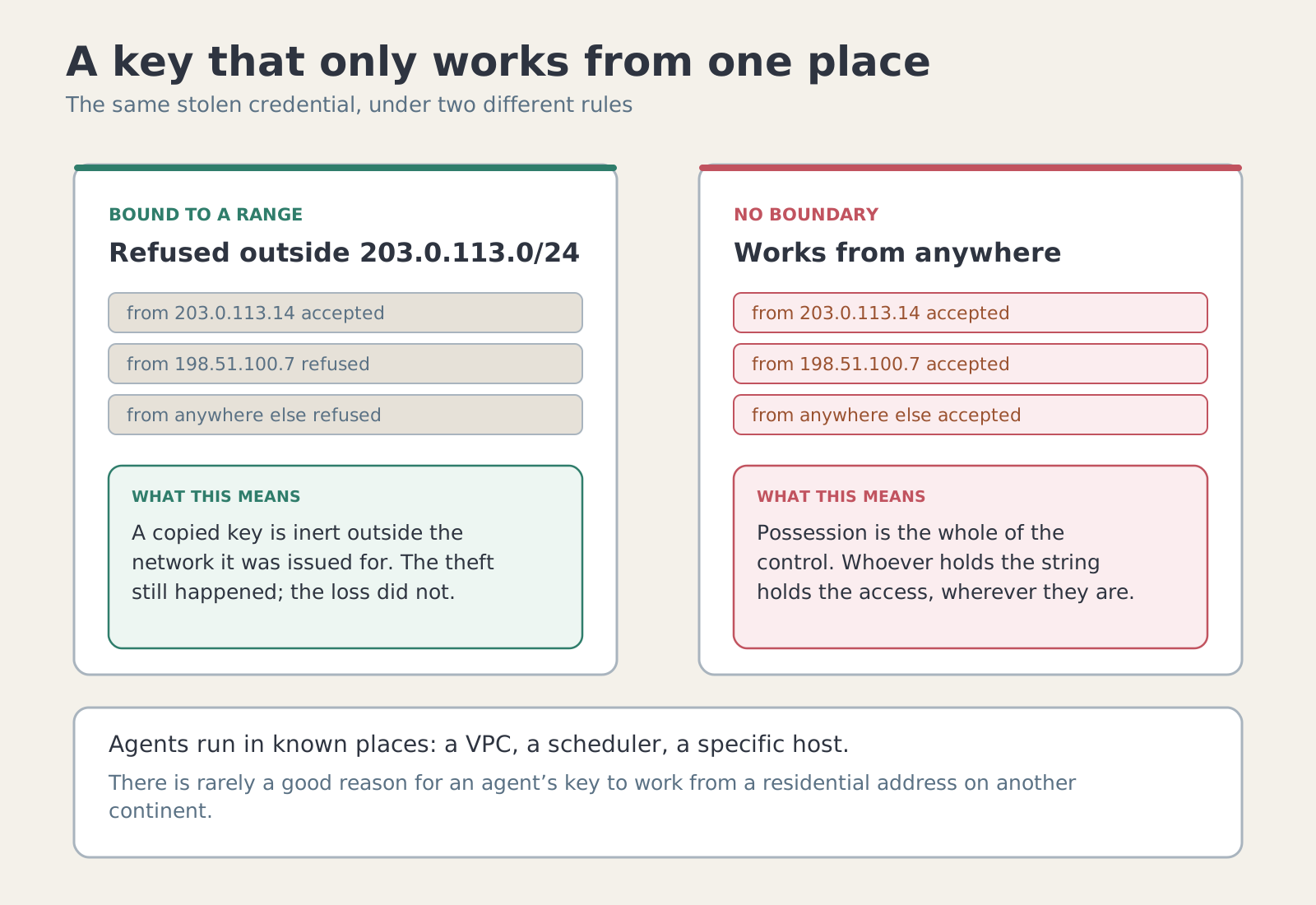
Where supported, bind an API key to an allow-listed IP or CIDR range. A copied key then has a narrower path to use than a bearer credential that works from any reachable network. WebFrolic’s security paper identifies IP restrictions on API keys as an important control, especially for integrations and AI agents that call third-party systems.
Network binding does not make a leaked key harmless. An attacker may operate from an allowed environment, compromise a trusted workload or abuse a proxy. Combine network restrictions with least privilege, rate limits, rotation, monitoring and revocation.
Design for real deployment conditions
List where the credential is expected to be used: fixed server egress, a private network, a controlled proxy or a managed workload. Document how those addresses are maintained and what happens when infrastructure changes. A rule that breaks every deployment will eventually be bypassed if there is no safe change process.
A proxy IP may identify a network boundary rather than one workload. The key’s permissions must remain narrow enough that another service behind the same proxy cannot gain unintended authority. Network identity complements application identity; it does not replace it.
Keep scope and ownership explicit
Know who owns the key, which application or service identity it represents, what resources it can access and how it will be revoked. Avoid keys created under personal accounts for business-critical integrations. If the person changes role or leaves, the organisation should not discover an undocumented job depends on their credential.
WebFrolic documents network controls for roles, service accounts and API keys, along with visibility and control for API keys. Validate the precise binding and revocation behaviour in the deployed environment, including the effect of caches and existing sessions.
Test the failure mode safely
Test from an approved and a disallowed network. Confirm the key works only where intended, denied calls create useful telemetry, and administrators can update approved ranges without losing track of the change.
During an incident, responders should be able to disable or rotate the key, trace use and identify dependent workloads. A good control gives operators a fast, observable way to contain exposure.
The short version
Bind keys to approved networks where the deployment supports it. Then: bind keys to approved networks where the deployment supports it; keep each key’s roles, resource scope and ownership narrow; document proxy and egress changes as security-sensitive configuration.
Implementation guide
A defensible API-key boundary, from issuance to revocation
Imagine a deployment credential used by a billing integration. The key is stored in a secret manager, injected into a workload at runtime, and used to call an API. A leak is serious—but impact depends on what the key can do, where it can be used, how quickly it can be revoked and whether the owner can identify its activity.
Think in independent layers
- Secret handling
- Scope and ownership
- Network boundary
- Monitoring and revocation
Network restrictions are valuable as a compensating boundary: a copied key used from an unexpected egress network should be denied when the policy is enforced correctly. They are not a replacement for least privilege, secret storage, rotation or incident response. A trusted proxy configuration also matters: the enforcement point must not accept a client-supplied source address as authoritative.
Keep the intended policy reviewable
# Illustrative policy checklist — not a WebFrolic API schema
credential:
  purpose: "invoice-sync"
  owner: "finance-integrations"
  environment: "staging"
  allowed_resources:
    - "invoice:write"
  allowed_egress:
    - "198.51.100.0/24"  # documentation-only example range
  expiry_review: "2026-12-01"
  rotation_owner: "finance-integrations"
  on_unexpected_network: "deny-and-alert"
Use documentation-only IP ranges in examples. In a real deployment, the address list should reflect controlled egress points—such as a NAT gateway or runner pool—and be maintained with the infrastructure change process.
Design for normal network changes
Cloud deployments change egress addresses. CI runners are replaced. A proxy may be added between a workload and the resource. If the allow list is too brittle, engineers will ask for a broad exception or disable the control during an outage. Maintain a clear owner, a documented change path, expiry or review dates, and a safe recovery procedure for legitimate egress changes.
Verify the boundary
Five failure tests
- A key from an approved workload and approved egress range can perform only its intended actions.
- The same key from an unapproved network is rejected where network enforcement is configured.
- Client-controlled forwarded headers cannot spoof a trusted proxy's source-IP decision.
- Rotation and revocation work even if a workload is still holding an older copy.
- Logs identify the key or service principal, resource, decision and outcome without recording the secret itself.
What to log—and what not to log
Record the credential identifier or service identity, request time, resource, action, source network signal, decision and correlation ID. Never write the raw API key into application logs, traces, error messages or analytics. Log redaction must be tested: accidental secret disclosure often enters through debug statements and request dumps rather than the primary auth handler.
WebFrolic's documented catalog includes API-key network rules and controls for service identities. Validate the available enforcement points and exact behavior in the target environment before relying on them as a production boundary.
Further reading
- OWASP API Security Top 10: API-specific risk areas and defensive guidance.
- OWASP Secrets Management Cheat Sheet: handling and lifecycle of secrets.
- WebFrolic API Keys and Advanced Network / IP Rules.
Design principle: a network boundary reduces where a credential can be abused; scope, ownership, safe storage and revocation reduce what an attacker can do with it.